
Sunday, March 27, 2016

Star of the Sea
Easter Sunday was a quiet day. We had intended to walk into
town for the parade marking the Rising but Brad was sick with a fever, and we just stayed in the barracks. It was a chance to catch up on
photos and blogging and email and for Brad to recover. In the evening, I went to Easter Mass at St Mary’s
Star of the Sea church in Sandymount, retracing our steps from the day before.


It
was a special 6 pm Mass for parishioners who had attended the parade during the
day. As I mentioned, my parents were living in Sandymount when I was born, so
this was the church where I was baptized. My cousin John suggested I shout out when I arrived, "I'm back!" (I did not do that.)

I think I also tracked down the house
where we lived then, 2 Sandymount Road (did I mention it was windy and cold?).

On the walk home I encountered threatening thunderheads over the Liffey, a patriotic household, and a nice statue of Mary in a hallway.


Family Connections and Eating Well


While in Ireland, I am visiting cousins on my mother’s side, children of her younger brother, Michael Bergin. I’ve mentioned Kay and Alan in Quinagh, and Breda and her husband, Tom, who live in Rathnapish, Co Carlow. After the Sinn Fein event in Dublin on Friday, we had dinner with Mary Bergin and her boyfriend, Liam Gallaher. On Saturday, we had a family brunch in the coastal suburb of Sandymount, where my parents were living when I was born.
Another cousin, John Bergin, and his wife, Hazel, were there as well as Mary and another of their sisters, Siobhan, who had flown in with her children Sebastian (12) and Lili (9) from London, where they live.
 |
| Sebastian & Lili on Pigeon House slide |
 |
| Pigeon House Power Station, Sandymount Strand, Dublin |
 |
| Brad at Kay's |
 |
| Alan at Kay's |
 |
| Kidney tapas! |
We are using Airbnb in Dublin and Rome. In Dublin, we are staying in Beggars Bush in a complex called Haddington Barracks, a former British Army barracks turned over in 1921 to Michael Collins on behalf of the Free State.


The barracks are now condominiums. Our host, David Timoney, works for a cell phone company and advocates on behalf of cyclists in Dublin. Here is David (in the blue vest) with the Lord Mayor of Dublin, Sinn Fein councillor Críona Ní Dhálaigh (foreground).

Friday, March 25, 2016
The Rising: Kilmainham to Arbour Hill

Up to Dublin on the train today for
the main commemorations of the centenary of the Easter Rising. The actual
events began on Easter Monday in April 1916, when members of the Irish Republican
Brotherhood (a precursor to the IRA), the Irish Volunteers, and the
Irish Citizen Army (a group formed to protect workers in the general strike of
1913) took over several locations in Dublin, most notably the General Post
Office (GPO) on O'Connell Street, and declared an Irish Republic on behalf
of Irish men and Irish women. Among other things, their proclamation declared "the right of
the people of Ireland to the ownership of Ireland" and guaranteed
"religious and civil liberty, equal rights and equal opportunities for all
it citizens." The poorly
equipped and trained rebels held positions for 5 days. When they
surrendered, central Dublin was in ruins, having been shelled by British ships
sent in to put down the rebellion. Although public opinion was generally
against the rebels, the summary execution of their leaders in the following days
led to popular support for independence from Britain, which eventually
occurred in 1921 when a Free State was established consisting of 26 of Ireland’s
32 counties. Six counties in the north became Northern Ireland, which remained
part of the United Kingdom. Decades of troubles followed, of course. The
history is still so raw and controversial, that the marking of the
centenary has been muted and conflicted, witness this editorial in the New York Times. To
summarize the writer's position: there shouldn't have been a Rising but
there should be a republic. In my humble opinion, I don't know how a republic
would have happened without something similar to the Rising …

Wanting to see some nationalist
observations, Brad and I attended a Sinn Fein sponsored march from Kilmainham
Gaol, where the 1916 leaders were executed, to Arbour Hill cemetery,
where they are buried.
There were pipe and drum bands from Belfast and New
York. |
| Marchers outside Kilmainham |

 |
| 1916 drum |
 |
| IBEW Local 3 band |
A contingent of U.S. labor union members (with Brad, on the left, just retired as Executive Director of the Northwest Local of SAG-AFTRA).

Local historical society
members in period garb.


The president of the women’s auxiliary of the Ancient
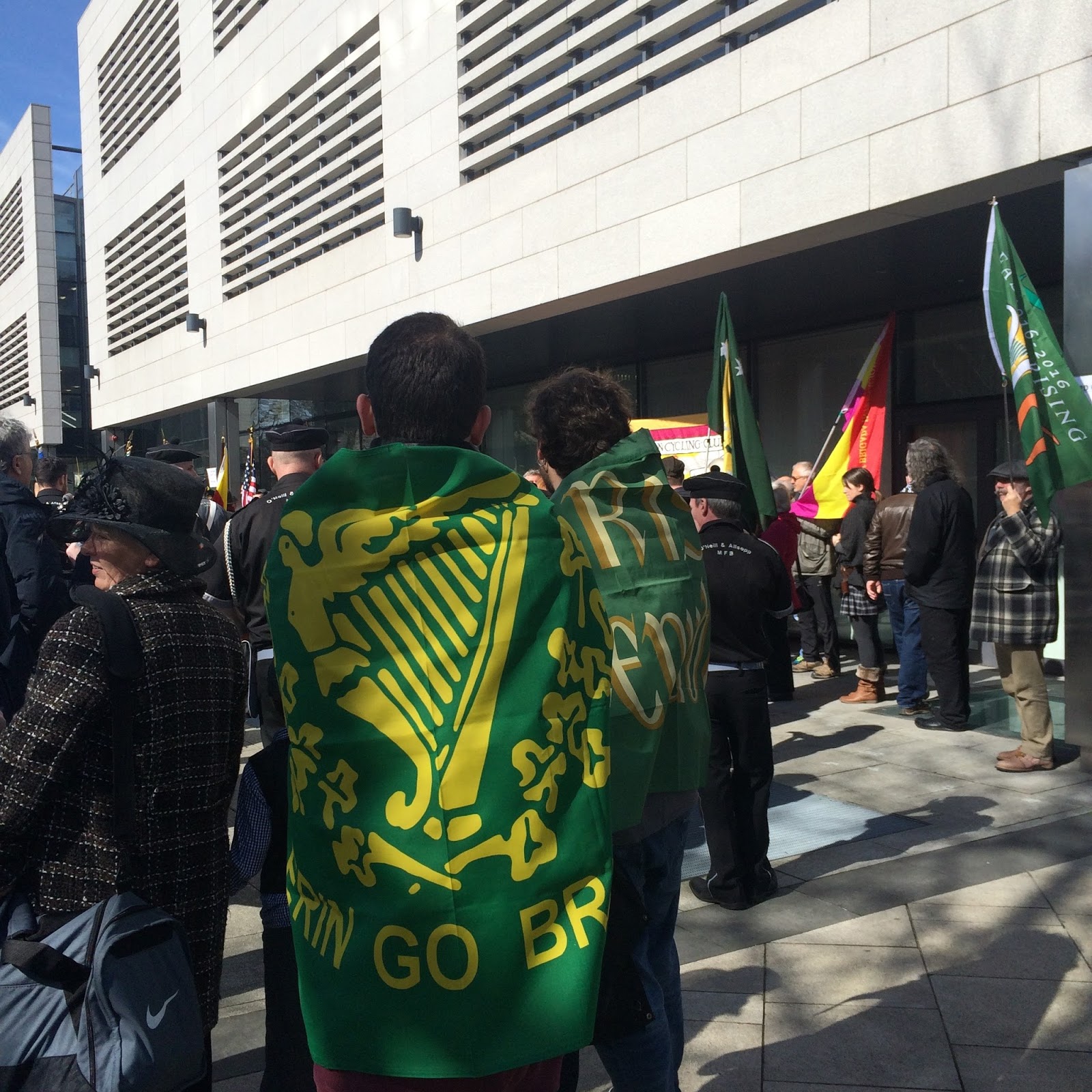
Order of Hibernians (who traveled from Brooklyn and laid a wreath on one of the Arbour Hill graves) and a number of marchers literally wrapped in the flag.


Gerry Adams, current head of
Sinn Fein, was the main speaker at the end of the march.
 |
| Adams (with beard) just before speaking |
Sinn Fein is the
political arm of the IRA and has recently gained an increasing share
of votes in both Northern Ireland and the Republic. Adams is a controversial
figure, who was involved with negotiating the Good Friday accord that effectively stopped the fighting in the North
but was always suspected of being an active IRA member involved with killings,
in particular the notorious 1972 case of a Belfast woman and widowed mother of
10, Jean McConville, killed for suspicion of being a British Army informant.
His speech was a defense of the Rising and focused on elements of the original
1916 proclamation but also on current social issues like income inequality, poverty
and homelessness, and equality for women. Some claim that Sinn Fein uses these
issues only to create a veneer of respectability but I was struck at
points by how much Adams sounded like Bernie Sanders!
 |
| Up the Republic |
Subscribe to:
Posts (Atom)